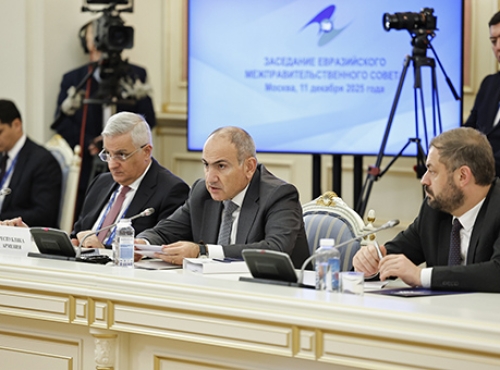
Armenian Prime Minister Nikol Pashinyan, addressing the extended session of the Eurasian Intergovernmental Council in Moscow, emphasized the need to establish mutually beneficial cooperation among all EAEU member states.
He underscored Armenia’s interest in expanding the geographic scope of the Union’s external economic relations, viewing it as a key factor in strengthening the organization's global economic role, Armenpress reports.
“Signing new free trade agreements not only enhances dialogue but also boosts the competitiveness of the EAEU, opening new economic growth opportunities for our countries. Another vital area of economic cooperation is the transport and logistics sector. Diversifying transport infrastructure can give a fresh impetus to trade turnover,” he noted.
Pashinyan added that positive regional developments create new opportunities for deeper economic collaboration. He emphasized that unblocking regional communication routes could play a crucial role in expanding interconnectivity and reinforcing the economic stability of all countries in the region.
“In this regard, I welcome the decision of the President of the Republic of Azerbaijan to unblock the transit of goods to Armenia via Azerbaijani territory. This is one of the key achievements within the framework of securing peace and stability in our region,” he said.
Pashinyan also pointed out the importance of forming common energy markets to ensure equal and predictable conditions for all EAEU member states. He stressed the need for full-fledged, efficient common markets that ensure effective interaction, transparency, and balanced interests.
“At the same time, it is particularly important for EAEU members to prioritize internal supply over exports to third countries and develop unified approaches to implementing this principle. Given the high volatility of global food markets, ensuring the resilience of agricultural systems in EAEU states is especially vital for maintaining economic stability,” he said.
He emphasized that achieving tangible results directly depends on coordinated practical actions, including systematic innovation adoption, digital transformation, and the development of effective financial support mechanisms for joint industrial and agro-industrial cooperation projects.
Pashinyan also addressed the development of favorable conditions for e-commerce in the EAEU, suggesting that future stages focus on consistent implementation of digital solutions and ensuring compatibility of technological approaches across member states. This would simplify e-commerce operations and support the sustainable development of the digital ecosystem.
As part of broader digitalization efforts, he stressed the importance of initiatives aimed at transforming sectors such as customs and transportation.
In the area of cybersecurity, he said priority should be given to creating joint mechanisms for protecting information, strengthening the resilience of critical infrastructure, and developing unified standards and methodologies to respond to cyber threats.
At the close of the session, the heads of government of member states ratified the adopted decisions.