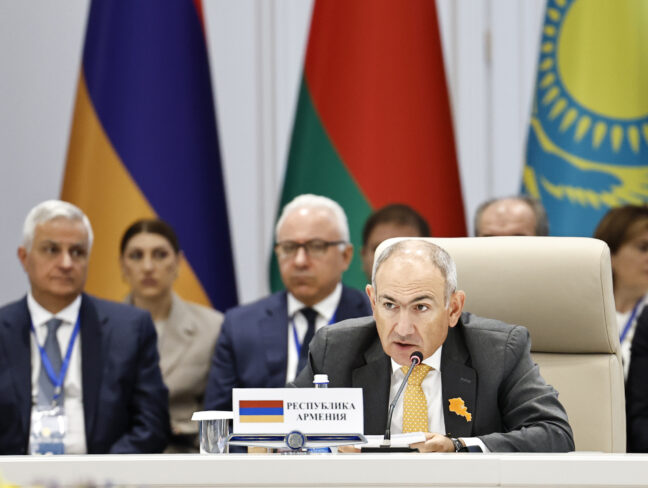
Prime Minister Nikol Pashinyan said in a speech at an expanded meeting of the Eurasian Intergovernmental Council in Cholpon-Ata that Armenia consistently advocates adherence to the principles underpinning the Eurasian Economic Union.
“One of the fundamental principles of the Eurasian Economic Union is ensuring the free movement of goods, services, capital and labor. Unfortunately, in practice these principles are not fully implemented. Certain restrictions and administrative measures continue to impede the full functioning of the common market, reducing the predictability of business conditions and the effectiveness of integration processes.
Armenia consistently ensures the most favorable, equal and non-discriminatory conditions possible for businesses from all EAEU member states. We consistently proceed from the principle that a similar approach should apply throughout the Eurasian Economic Union.
For this very reason, we consider it fundamentally important that any measures capable of affecting access of member states’ goods and services to the common market be adopted exclusively in accordance with EAEU law, based on coordinated procedures and within the framework of constructive interaction between the competent authorities.
Ignoring such issues could not only impede the further development of the Eurasian Economic Union but also negatively affect attitudes toward it among our countries’ citizens and business communities. Ultimately, such problems cease to be problems of an individual member state. They become a common problem for the entire union. That is precisely why we need to promptly eliminate emerging barriers, prevent a decline in trade and economic relations within the EAEU, minimize reputational and business risks, and consistently strengthen mutual trust,” the prime minister said.
He also spoke about economic indicators that, he said, convincingly demonstrate that Armenia’s participation in the Eurasian Economic Union is based on fulfilling mutual obligations rather than obtaining unilateral advantages.
“In 2025, Armenia transferred about $319 million to the EAEU’s common budget from import customs duties, while the amount distributed to Armenia was about $175 million. Thus, Armenia transferred significantly more funds to the Union’s common budget than it received, which directly confirms our responsible position and conscientious fulfillment of our obligations within the EAEU.
The dynamics of mutual trade are no less telling. According to 2025 results, imports from EAEU member states amounted to about $5 billion, while exports of Armenian products to the Union’s market totaled about $3.2 billion during the same period. These figures demonstrate that the Republic of Armenia is not only a participant in the EAEU common market but also an important consumer of goods produced and services provided in the Union’s member states,” Pashinyan said.
He added that Armenia had taken note of the May 29, 2026 statement by the leaders of four EAEU member states expressing support for the idea of holding a referendum in Armenia on membership in the European Union.
He said the existence of possible alternatives is a factor that will contribute to increasing the EAEU’s competitiveness and attractiveness.
“I should note that in the current relationship between Armenia and the European Union, there are no legal, economic or political obligations that contradict the status of our relations within and under the EAEU.
Armenia proceeds from the principle that the Eurasian Economic Union should not be viewed as a space of restrictions. We are convinced that cooperation between EAEU member states and third partners should not be perceived as a zero-sum game. The EAEU will be all the more attractive the more consistently we uphold our own agreements and respect each other’s sovereign rights,” Pashinyan said.
During the meeting, protocols were signed on the issues discussed and approved. They concerned cooperation and regulations in the areas of transport, e-commerce and education.
In his speech, Pashinyan also addressed calls for a referendum concerning EAEU and EU membership, saying that holding such a referendum would be devoid of substance and would mean asking citizens to answer a question that simply does not exist at present.
“That would mean we expect Armenian citizens to choose between two alternatives, one of which does not exist. It would be disrespectful toward our people and, in practical terms, illegitimate. I am grateful to my EAEU colleagues for recognizing the legitimate right of Armenia, like any other EAEU country, to develop relations with various partners and create trade and economic alternatives for its own country,” Pashinyan said at the meeting.