Education, Science, Culture and Sports Minister Zhanna Andreasyan said the low results recorded by Armenian students in the international PISA assessment were not unexpected, linking them in part to shortcomings in the old education standards. She made the comments in an interview with Shant TV.
According to the assessment results, about 1% of Armenian students achieved top performance in mathematics. In science, almost no students were top performers, while in reading, virtually no students reached Level 5 or higher. Based on these indicators, Armenia ranked last in the region, behind Georgia, Azerbaijan and Turkey, CivilNet reported.
Commenting on the latest assessment by the Organisation for Economic Co-operation and Development (OECD), the minister stressed that these indicators primarily serve as baseline and starting-point data for Armenia.
They will make it possible to assess the progress of reforms being implemented in general education and measure improvements.
“PISA came to prove that everything we have undertaken in education represents the right steps. PISA says that practical application is a problem for our children. And how are they supposed to apply their knowledge of natural sciences, and in what environment, if our schools had no laboratories for years where, for example, they could conduct chemistry or physics experiments and have the opportunity to apply and observe in reality the principles they had studied? Instead, under the previous standards, we filled our school curriculum with all sorts of things and consumed children’s time with a wide variety of content. The conditions for natural sciences did not exist, and we had a severe shortage of teachers,” the minister said.
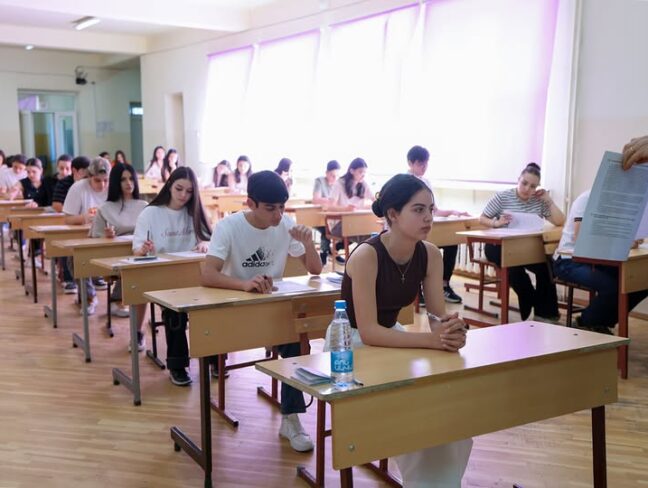
According to information presented by the minister, more than 6,800 students participated in the assessment conducted from March to May 2025 at 295 schools selected by the OECD, with 88% of participants being 10th-grade students. Andreasyan noted that these students had been educated under the old knowledge-centered standards, while at the time of the assessment they had studied under the new competency-based standards for only five to six months.
“These baseline data demonstrate all the problems with our old standards. As you know, our old standards were primarily based on transferring knowledge rather than teaching how to apply that knowledge,” the minister said.
According to figures presented by Andreasyan, only one in three students educated under the old standards was able to apply mathematical and scientific knowledge in different situations. At the same time, only one in five had developed reading skills sufficient to make judgments and draw conclusions about a text.
Andreasyan said that, to address problems accumulated in the education system over the years, 86% of schools have already been equipped with science laboratories, with all schools expected to have them by the end of the year. In addition, following the introduction of additional payments for science teachers, the teacher shortage has been halved compared with 2023, falling from 1,400 to 700. According to the minister, this figure is lower than the average for OECD countries.
Addressing teacher qualifications, the minister stressed that one in three teachers has now undergone voluntary certification, while the 200,000-dram salary rate set for those achieving high results will be replaced by a 300,000-dram rate. She also reaffirmed that teachers who do not pass certification will not be able to continue working in schools. At the same time, the government plans to adopt a law on the status of teachers that will provide for social and housing support programs.
According to the minister, funding allocated to general education has increased by 192% compared with 2018.
Andreasyan said the full impact of the new standards will be visible in the 2029 PISA assessment, when students educated entirely under the new system will be evaluated.