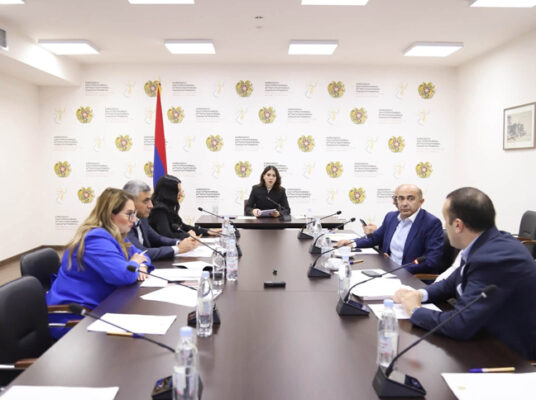
The Corruption Prevention Commission (CPC) rejected a request to initiate proceedings concerning Prime Minister Nikol Pashinyan, assessing individual instances of his public speech in the context of political debate, Factor.am reported.
Semyon Babayan, chairman of the Public Whistleblower human rights NGO, applied to the Corruption Prevention Commission seeking proceedings over alleged violations of conduct rules by Prime Minister Nikol Pashinyan. He argued that Pashinyan’s recurring public statements and choice of language “clearly violate the integrity framework established by law and ethical standards for public officials.”
Babayan said those obligations had been seriously breached in 11 key instances and statements.
The first concerned the alleged targeting of spiritual values through the description “impure” directed at the Catholicos of All Armenians, which the applicant argued offended the feelings of Christian believers and violated the requirement of religious neutrality.
The second cited an alleged violation of the separation of powers through the public assertion, “There is no judge who would not do what I say,” which, according to Babayan, directly undermined the independence of the judiciary and the standing of democratic institutions.
The third point concerned the use of insulting language. It referred to Pashinyan’s use of the phrase “dogs and riffraff” and similar street language toward opponents or citizens in public forums, which the applicant considered incompatible with the ethical standards expected of a senior official.
The fourth instance concerned allegedly unfounded and arbitrary estimates, including public claims that corruption and bribery rates stood at 70% or 100%, without official or verified factual data.
The fifth point cited the erosion of public trust through threats and divisive rhetoric from the country’s highest state platform, which the complaint said contributed to the spread of intolerance in society.
The sixth instance concerned threats to “lay people out on the asphalt” and “smash them against walls,” presented as personalized and punitive public directives involving coercive force outside legal procedures.
The seventh point concerned the description “whining judges,” which the applicant characterized as degrading the dignity of representatives of the judiciary and systematically discrediting the institution.
The eighth instance cited statements about “bringing citizens to their knees” over their political views, which were presented as fostering a culture of speaking from a position of force and command that is inappropriate for a public servant.
The ninth point concerned the differentiation of compatriots through the phrase “Armenians by origin,” which the applicant regarded as violating the principle of national unity and artificially dividing society.
The tenth instance concerned allegedly biased and preferential treatment of Pashinyan’s own team, presented as a violation of the principle of equal integrity standards for reasons of political expediency.
The eleventh point raised the issue of undermining standards of integrity and the image of a statesman through the continued use of marginal, sarcastic and aggressive language in public speech, which, according to the applicant, compromised a public official’s obligation to set an example.
The CPC found no grounds to initiate proceedings over Prime Minister Nikol Pashinyan’s use of the word “impure” in reference to the Catholicos of All Armenians, concluding that the statement did not exceed the legitimate boundaries of freedom of expression.
In its decision, the commission first referred to the case law of the European Court of Human Rights (ECHR), stressing that political speech enjoys a particularly broad scope of protection. According to the CPC, sharp, exaggerated or disturbing language may also be permissible in political debate.
“Within political debate, political speech delivered, in this case, from the parliamentary rostrum is characterized by the use of exaggerations, generalized judgments and even shocking or startling expressions,” the decision states.
The commission also recalled the ECHR’s position that freedom of expression applies not only to speech perceived favorably or as harmless, but also to expressions that may “offend, shock or disturb.”
The CPC attached particular importance to the fact that Pashinyan made the remarks in the National Assembly during the presentation of the government’s five-year program and in response to a question and reaction from lawmaker Sevak Khachatryan. The commission said the remarks concerned a matter of public interest and had to be considered within the overall context of political debate.
In its decision, the CPC also addressed the meaning of the Armenian word “pighc,” translated here as “impure,” used by Pashinyan. The commission cited Eduard Aghayan’s Explanatory Dictionary of Modern Armenian, according to which the word primarily means “dirty, unclean, defiled,” and in a religious sense, “incorrect, misguided, religiously impermissible, unholy.”
The commission assessed that in Pashinyan’s phrase “your Catholicos is impure,” the word was directed not against a faith or any religious group but was used in the context of assessing the alleged conduct of a specific cleric.
“The primary purpose of N. Pashinyan’s speech was not to criticize the person, but a specific phenomenon — the alleged violation of the vow of celibacy,” the commission stated.
The CPC also stressed that it had not assessed the truthfulness or legality of the factual claims made by Pashinyan.
“The commission does not assess the legality of the factual circumstances, but exclusively considers whether the expressions used by the prime minister in this situation constituted lawful speech,” the decision states.
According to the commission, although the word “impure” carries a negative connotation, it did not reach the level of profanity or vulgarity: “Despite its negative nuance, the expression used did not cross the threshold into vulgarity or profanity.”
The CPC also found that Pashinyan’s speech contained no calls for violence, threats or incitement to hatred or hostility. At the same time, the commission considered whether the expression could be regarded as a purely personal insult.
According to the decision, the “primary and sole purpose of the speech was not to insult”; rather, it “was predominantly critical in nature, which is characteristic of political debate and political speech.”
As additional justification, the CPC also cited the ECHR’s Klein v. Slovakia case, in which the court distinguished harsh criticism directed at a specific church official from speech targeting a religious group or faith. On that basis, the commission concluded that sharp criticism of a cleric’s personal conduct or public activities cannot automatically be regarded as an offense to religious feelings.
As a result, the CPC concluded that no indications of an apparent violation of the relevant rules had been established and declined to initiate proceedings.