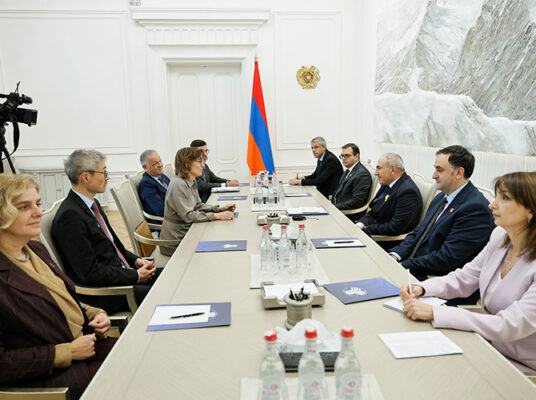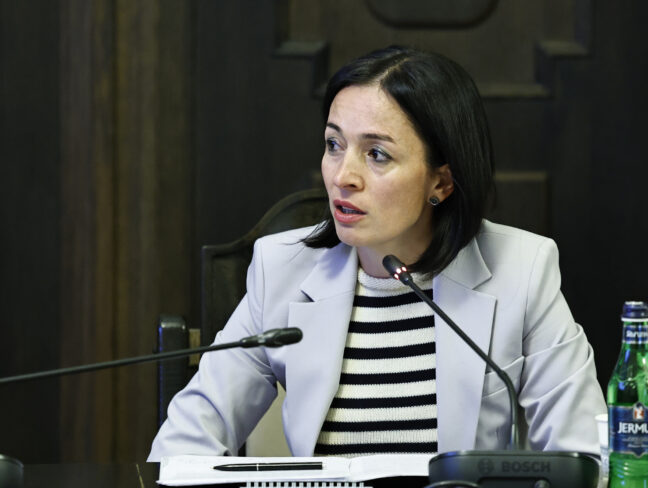
Armenian Minister of Education, Science, Culture and Sports Zhanna Andreasian addressed the results of the international PISA assessment at a government meeting, saying the identified problems had been diagnosed long ago and reforms implemented in recent years are aimed at resolving them.
According to the minister, Armenia’s participation in PISA was a decision by the Armenian government aimed at obtaining internationally comparable data, using it to accurately diagnose problems in the education system and clarify further steps, 1lurer.am reports.
A total of 91 countries participated in this PISA cycle. The assessment was conducted in Armenia from March to May 2025 and covered around 7,000 15-year-old students from 295 schools. At the time of the assessment, 88% of participants were 10th-grade students whose education was organized under the old curriculum standard.
“PISA assesses not only students’ basic knowledge, such as literacy or the ability to perform simple arithmetic operations, but also how effectively students can apply their knowledge in different real-life situations. In this regard, the PISA results also confirm that the measures initiated in recent years under the government program and Armenia’s 2021-2030 State Program for Education Development are aimed at addressing correctly diagnosed problems,” the minister said, listing the ongoing measures.
Andreasian specifically pointed to the provision of laboratory facilities in schools, construction of new educational institutions, incentive mechanisms for science teachers and policies aimed at reducing teacher shortages.
Compared with 2023, the teacher shortage has declined by around half. Approximately 4,000 new teachers have started working in schools over the past two academic years, 80% of whom are under 45, while more than half work in rural schools.
Since 2023, a supplementary payment system has also been introduced for teachers of science subjects and teachers at schools with up to 100 students. Laboratories have already been provided to 86% of schools, while all schools are expected to receive the necessary facilities by the end of the year.
According to the minister, these figures show that government policies aimed at improving teachers’ working conditions and remuneration have already produced certain results and made the profession more attractive.
“At present, according to the same assessment data, the teacher shortage in our country is significantly lower than across countries of the Organisation for Economic Co-operation and Development, and our policies are already producing results,” she said.
Andreasian also recalled that an additional pathway has been created for people with higher education in science-related fields but without teaching qualifications to work in schools.
“There is considerable interest here as well. We have recruited several hundred new teachers through this mechanism,” the minister said.
She noted that separate pedagogy and psychology courses have been introduced, after completing which and obtaining the required credits, these specialists can teach in schools.
“I am confident that the work we are carrying out across all areas will allow us to see different results in our schools during the next PISA international assessment, which will take place in 2029. But it is also very important that existing problems are diagnosed correctly, and if something needs to be changed or improved in our further steps, we must pay close attention to that as well. It is truly important that discussions remain professional,” Zhanna Andreasian emphasized.
The discussion also addressed transportation and access to transport for children attending cluster schools. It was noted that the government has already introduced a mechanism for reimbursing transportation costs.
According to the minister, parents who decide to have their children attend newly built, renovated or extensively refurbished cluster schools can receive reimbursement for transportation expenses. Other decisions concerning means of transportation are expected to be clarified in the near future.
Prime Minister Nikol Pashinyan, for his part, stressed the importance of consistent work to address the identified problems, noting that strategic programs implemented by the state in education in recent years are aimed at improving education quality — from creating and upgrading infrastructure to reviewing and changing educational content.
According to the PISA international assessment results, around 1% of Armenian students achieved the highest results in mathematics. Almost no students achieved the highest results in science, while virtually no students reached Level 5 or above in reading. By these indicators, Armenia ranked last in the region, behind Georgia, Azerbaijan and Turkey.
Andreasian said the low results recorded by Armenian students were not unexpected, linking them in part to shortcomings in the old education standard.