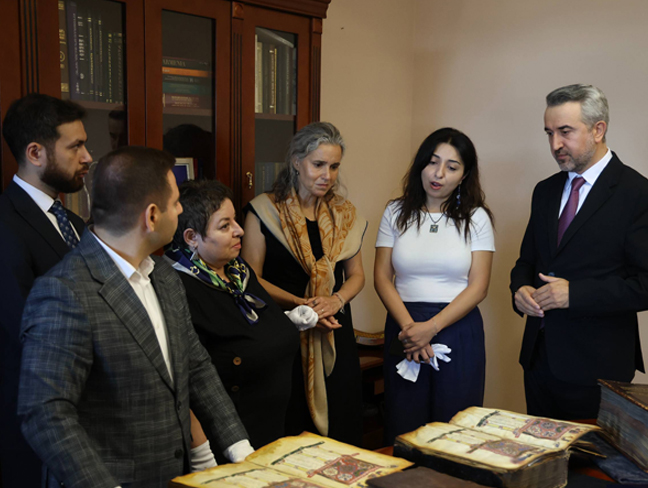
EU Special Representative for the South Caucasus and the crisis in Georgia Magdalena Grono said she does not dispute the Armenian presence and rich legacy in areas of Karabakh formerly affected by conflict, stressing the importance of preserving cultural heritage. She made the remarks in Yerevan, where on Sept. 14 she visited the Matenadaran accompanied by Armenian Deputy Foreign Affairs and International Trade Minister Vahan Kostanyan, Armenpress reported.
She said preserving and supporting cultural heritage is not only an important component of peace processes but also holds significant value for the European Union.
“I am glad that today I had the opportunity to visit the Matenadaran and see the wonderful collections of ancient Armenian heritage. I saw the true beauty and depth of that heritage and am deeply impressed. I am very grateful to our hosts for providing this opportunity, and I am convinced that preserving and supporting cultural heritage is not only an important part of peace processes but also an essential value for the European Union,” Grono stressed.
The previous day, Grono visited Azerbaijan and Karabakh, after which she wrote on social media that “there are deeply differing views and narratives regarding the origins of certain sites,” without specifying exactly what she meant. The post drew criticism in Armenia.
Asked by an agency correspondent how she interpreted that post, the EU special representative replied:
“I certainly do not dispute the past Armenian presence and rich legacy in the formerly conflict-affected areas of Karabakh. During my visit last week to the Kalbajar district, where she visited Dadivank, and the Aghdara district, where she visited Gandzasar, I had the opportunity for the first time to see this for myself. I was also glad to visit the Matenadaran in Yerevan again today. This heritage must be preserved and valued, while avoiding unfounded politicization and manipulation,” she said.
Grono also noted that addressing all components of the peace process is a priority for the European Union. According to her, these include political, security and economic issues, as well as difficult topics such as humanitarian concerns and matters related to cultural heritage.
“I think that, at some point, dialogue on these issues will also be necessary to make reconciliation complete. I have heard the views of both sides and know that they evoke deep emotions. I was also glad that during my visit over the weekend I had an opportunity to see the important heritage that truly exists in Karabakh,” the EU Special Representative for the South Caucasus and the crisis in Georgia concluded.
European Commission spokesperson Christian Wigand said he would clarify the circumstances surrounding EU Special Representative for the South Caucasus Magdalena Grono’s post on X regarding Nagorno-Karabakh’s cultural heritage, noting that he was personally unaware of its content, Factor.am reported.
“Thank you very much for the question. My colleague has indicated to me that we need to follow up on this issue. We need to look into it. I am personally not aware of those comments,” he said at a briefing.
Factor TV had specifically sought to determine whether the participation of EU representatives in such visits and the use of such wording contribute to reconciliation or endanger peace by casting doubt on Armenian cultural heritage and the historical Armenian presence in the region.
Hikmet Hajiyev took diplomats accredited in Azerbaijan to Gandzasar and Dadivank, presenting them as part of the Christian heritage of “ancient Caucasian Albania.”