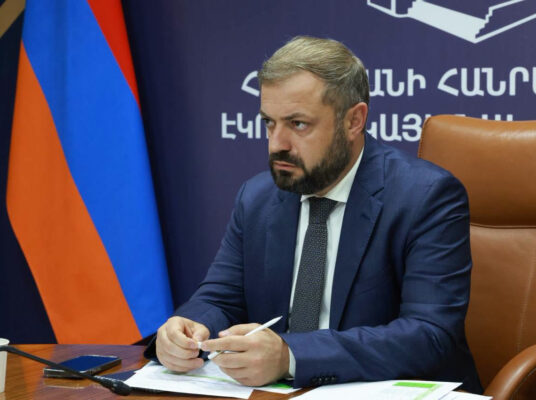
Armenian Prosecutor General Anna Vardapetyan participated online in a meeting of prosecutors general from Commonwealth of Independent States member states, speaking about the recovery of illicit assets from abroad.
She said the cross-border nature of modern crime has created new challenges for states. Illegally acquired assets can be transferred to different countries, registered in the names of affiliated persons and converted into other forms of property.
“Under these circumstances, asset recovery should be viewed as a comprehensive process, from identification and tracing to freezing or seizure, judicial proceedings, confiscation, management and actual recovery,” Armenia’s prosecutor general emphasized.
She added that the impossibility of criminal prosecution should not automatically mean that the recovery of illegally acquired property is impossible.
In this context, the prosecutor general addressed the mechanism of non-conviction-based asset confiscation. Vardapetyan presented Armenia’s experience, noting that the adoption of the Law on Confiscation of Property of Illicit Origin in 2020 created a legal basis for applying an independent civil-law mechanism to recover illegally acquired property.
Emphasizing the importance of effective international legal assistance, Armenia’s prosecutor general said international cooperation should begin as early as the asset identification and tracing stage, making it possible to promptly freeze, seize and preserve assets until domestic judicial proceedings are completed.
Vardapetyan also addressed the significance of the Council of Europe’s Warsaw Convention and its additional protocol adopted in 2026. She emphasized that representatives of Armenia’s Prosecutor General’s Office had been directly involved in drafting the protocol.
Armenia’s prosecutor general also outlined problems arising in the course of international cooperation. These are related to differences between countries’ legal systems, the absence of comparable civil-law confiscation mechanisms, as well as restrictions on subsequently using information obtained through informal channels as evidence.
Vardapetyan stressed the importance of further developing international cooperation in this area, highlighting rapid exchanges of information about assets, improvements to mechanisms for promptly freezing and seizing property, ensuring the availability of international legal assistance before a final court decision is issued, mutual recognition and enforcement of judicial decisions, and effective management of confiscated assets.
Concluding her remarks, Vardapetyan said asset recovery is no longer merely a matter of confiscating property after the completion of criminal proceedings.
“This is a comprehensive process that begins with identifying an asset, locating and tracing it, and ends with its actual recovery. Our common goal is to ensure that no legal vacuum emerges between the identification of an asset and its actual recovery,” Armenia’s prosecutor general said.