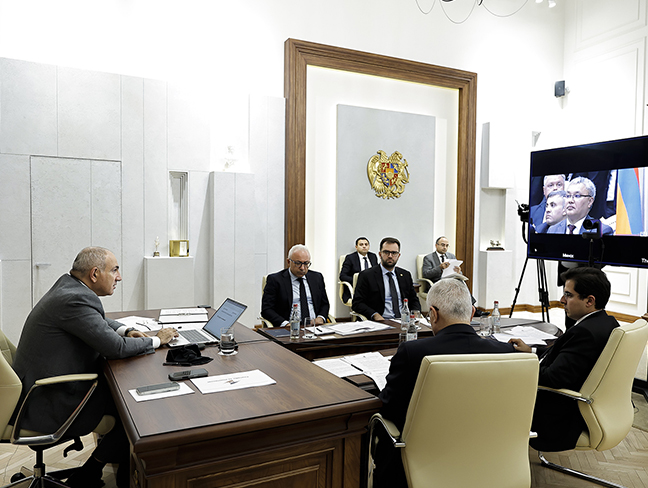
Armenia remains committed to continuing mutually beneficial cooperation within the Eurasian Economic Union, Prime Minister Nikol Pashinyan said while participating by video link in a meeting of the Eurasian Intergovernmental Council in Minsk.
He also stressed the importance of continuing dialogue on removing existing barriers to the export and transit of Armenian goods in accordance with EAEU law.
“We have repeatedly reaffirmed the Republic of Armenia’s commitment to continuing mutually beneficial cooperation within the EAEU, aimed at strengthening economic stability and ensuring sustainable development across the broader region.
Armenia consistently advances an agenda of peace and trade and transport connectivity in the region. As has been repeatedly stated, Armenia’s Crossroads of Peace initiative is aimed at creating new opportunities through the development of transport, energy and digital connectivity.
One of the key components of the Crossroads of Peace is TRIPP — Trump Route for International Peace and Prosperity. The TRIPP project will establish a direct railway connection between Armenia and Azerbaijan.
At the same time, the project will make it possible to integrate Armenia into the international railway network and create an opportunity to establish a rail connection between the Persian Gulf and the Black Sea.
This will become a significant development in transport connectivity, bringing changes for Armenia, Azerbaijan, Georgia and Iran.
During the restricted-format meeting, I informed my colleagues about certain aspects related to the unblocking of regional transport infrastructure, which is taking place as a result of the establishment of peace between Armenia and Azerbaijan. We expect certain solutions that, in particular, will lead to greater efficiency of the Republic of Armenia’s railways.
Certainly, ensuring the free movement of goods, services, capital and labor is the foundation for the full functioning of the EAEU single market.
At the same time, ensuring food security, the stability of domestic markets and the predictability of mutual supplies of agricultural products and food is an important component in developing and deepening economic cooperation,” he said.
The prime minister added that joint forecasts for the development of the agro-industrial sector and supply-and-demand balances make it possible to assess the needs of the member states more accurately, plan production and supplies, and identify new opportunities for mutual trade and realizing export potential in the EAEU market.
“Certainly, ensuring the free movement of goods, services, capital and labor is the foundation for the full functioning of the EAEU single market.
At the same time, the practical implementation of these principles continues to require our particular attention. Unfortunately, since my previous participation in the Intergovernmental Council meeting in Cholpon-Ata, we have not managed to achieve substantial progress on a number of outstanding issues.
In particular, restrictions and administrative barriers remain, continuing to significantly hamper the full and effective functioning of the single market.
In this regard, we consider it important to continue constructive dialogue aimed at removing existing barriers to the export and transit of Armenian products in accordance with EAEU law.
I am confident that consistent progress in this area is in the interests of all EAEU member states, ensuring stable trade flows, predictable conditions for market participants and the further strengthening of integration cooperation,” Pashinyan said in his address.
At the May 29 meeting of the Supreme Eurasian Economic Council in Astana, the presidents of four EAEU member states — Russia, Kazakhstan, Belarus and Kyrgyzstan — adopted a statement concerning the situation in Armenia. Armenia was urged to hold a referendum as soon as possible on choosing between the EAEU and the European Union.
Various Russian officials have also said in recent days that if Armenia continues moving toward the European Union, it could lose the opportunity to purchase Russian gas on preferential terms.
In addition, Russia has imposed restrictions on imports of Armenian products. In particular, imports from Armenia of Jermuk mineral water, flowers and certain alcoholic beverages have been banned. Restrictions have also been imposed on several agricultural products, including tomatoes, cucumbers and strawberries. Since June 2, Russia has restricted imports from Armenia of cherries, apricots, peaches, plums, grapes and other stone fruits, as well as their transit to other EAEU countries. Since June 3, Russia has restricted imports of eggplants, potatoes and dried fruits originating from and exported by Armenia.