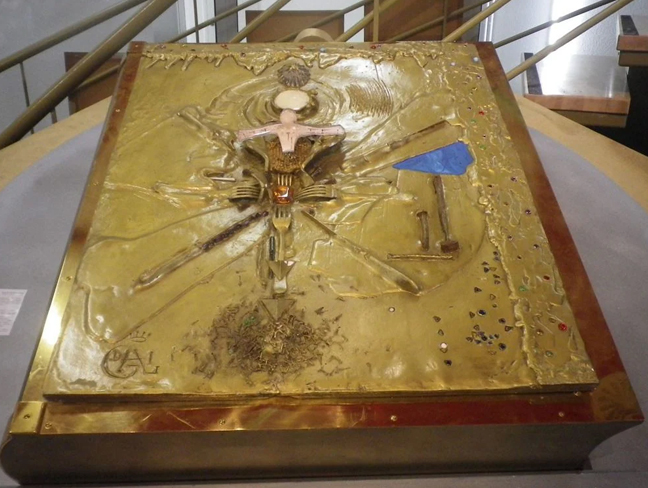
A 150-kilogram bronze book cover created by Salvador Dali has been stolen from a museum in central France. Authorities are still trying to determine how such a heavy artwork was removed from the building unnoticed.
The bronze cover of “Livre de l’Apocalypse,” known as “Book of Revelation” or “Apocalypse of Saint John,” was stolen overnight into October 6 from a contemporary art center in Issoire, in central France’s Puy-de-Dome department, Telegraph.co.uk reported.
The Clermont-Ferrand prosecutor’s office described the work, decorated with gold, precious stones and seashells, as an “exceptional and unique” artwork of “great value.”
The cover alone weighs 150 kilograms, while the complete book weighs 210 kilograms, making it one of the world’s heaviest books.
The work’s owner, Christian Karoutzos, compared the theft to an attack on France itself.
“Last night they killed France, they killed French heritage,” he told local radio.
The idea for the enormous volume was conceived in 1958 by Auvergne art publisher Joseph Foret, inspired by the biblical Book of Revelation.
The project brought together 14 prominent 20th-century artists and writers, including Jean Cocteau, Bernard Buffet and Jean Giono. Spanish surrealist Salvador Dali sculpted the book’s intricately designed bronze cover.
The complete work includes 150 enormous sheets of parchment made from the skins of 300,000 sheep. Creating the book’s calligraphy required 2,000 hours, while 550 letters in the text were gilded.
Between 1961 and 1972, the work was displayed at nearly 150 exhibitions around the world. It then disappeared from public view for a period, was kept in Switzerland and was later sold to Japanese owners.
They were preparing to sell the work piece by piece when Christian Karoutzos, head of an art restoration company in Issoire, acquired the book in 2003.
Karoutzos had been displaying the Dali-designed cover at his museum alongside several parchment pages until autumn. The Clermont-Ferrand investigative brigade of the gendarmerie is investigating the theft.
The theft of Dali’s work is the latest in a series of recent attacks targeting museums in France.
In October last year, thieves broke into the Louvre’s Apollo Gallery in broad daylight and stole royal treasures valued at about 88 million euros, dropping Empress Eugenie’s crown while fleeing.
In July, masked men broke into the Lalique Museum in Alsace and stole 27 objects worth 4.5 million euros in just 11 minutes. That same month, thieves posing as visitors took the 2,500-year-old gold necklace of the Princess of Vix from a museum in Burgundy.
In September, two other masked individuals broke into the Renoir Museum in Cagnes-sur-Mer and stole four paintings in less than three minutes. By the time police arrived, they had abandoned two of the works in the garden.