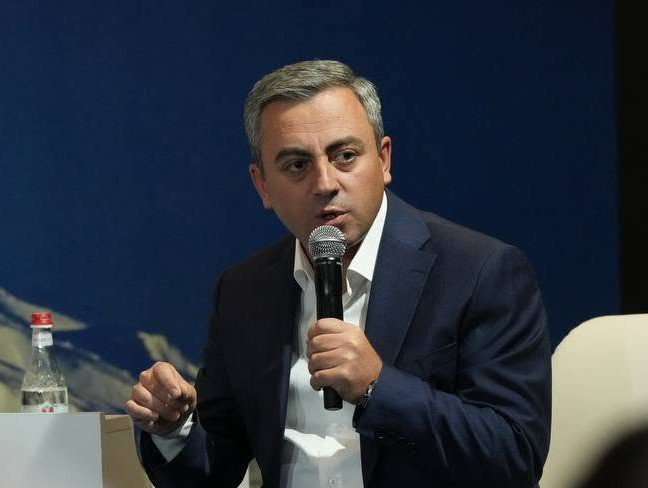
Ishkhan Saghatelyan, a member of the Armenian National Assembly’s opposition Hayastan faction, has published a Facebook post titled “What Has Nikol Pashinyan Conceded?”, responding to a question raised by the prime minister from the parliamentary rostrum.
He noted that he had previously presented the same list in the spring of 2025.
“Today, speaking from the National Assembly rostrum, Nikol Pashinyan expressed surprise and asked what exactly he had conceded. I presented this list in March 2025. It is a non-exhaustive list of Pashinyan’s major concessions. He would do well to read it and remain silent before asking that question again.
1.Following Pashinyan’s orders (under what he himself described as a ‘verbal understanding’), Armenia’s armed forces withdrew from their positions in December 2020, leaving commanding strategic positions in Syunik under Azerbaijani control. This concession was subsequently justified by citing the threat of war.
2.On May 12, 2021, Azerbaijani armed forces entered Armenia’s sovereign territory without encountering resistance, first near Sev Lake in Syunik province and then in the areas of Verin Shorzha and Kut in Gegharkunik province, occupying approximately 41 square kilometers. Once again, you surrendered strategic positions without resistance, asking whether we really needed those snow-covered mountains.
3.In November 2021, a 21-kilometer section of the Goris-Kapan interstate highway and part of the village of Shurnukh were handed over to Azerbaijan.
4.On November 15, 2021, the Azerbaijani side established a checkpoint on a section of the Kapan-Chakaten road. The road was thereby surrendered to the enemy, cutting off the shortest and most convenient connection between six nearby villages and Kapan.
5.In March 2022, Azerbaijani units advanced approximately one kilometer into the administrative territory of Nerkin Hand without firing a shot and under peaceful conditions. They erected five tents there, establishing control over additional territory.
6.In April 2022, Pashinyan announced that Armenia would lower the bar regarding the Artsakh issue, fulfilling an Azerbaijani precondition under which Armenia abandoned its commitment to defending Artsakh’s right to self-determination.
7.On August 25, 2022, Berdzor, Aghavno and Sus were handed over to Azerbaijan. The transfer of the Lachin corridor, which connected Artsakh to Armenia, along with the surrounding settlements, was not envisaged under the trilateral statement of November 9, 2020. The transfer of these settlements also placed the gas pipeline and electricity transmission line supplying Artsakh under Azerbaijani control, with devastating consequences during the blockade of Artsakh. Moreover, these developments allowed the enemy to advance toward the village of Tegh in the Goris area, seizing the village’s agricultural land and pastures.
8.On September 13-14, 2022, Azerbaijani armed forces entered Armenia’s sovereign territory along the Gegharkunik, Syunik and Vayots Dzor directions, bringing the total occupied area to 220 square kilometers. We suffered more than 200 fatalities, primarily because strategic positions in those directions had previously been surrendered.
9.Through a verbal agreement in Prague in 2022, followed by a written agreement in Granada in 2023, Pashinyan fulfilled another Azerbaijani demand by recognizing Artsakh as part of Azerbaijan. In Granada, Pashinyan even signed a unilateral document recognizing Azerbaijan’s territorial integrity with a specified area of 86,600 square kilometers. In return, Aliyev has yet to recognize Armenia’s territorial integrity with clearly defined territory and borders. Azerbaijan subsequently cited these very statements when blocking the Lachin corridor and laying siege to Artsakh.
10. In September 2023, during the attack on Artsakh and the ethnic cleansing carried out there, Pashinyan fulfilled another Azerbaijani demand by leaving the Armenians of Artsakh on their own and publicly renouncing responsibility for ensuring the security of approximately 120,000 people who were Armenian citizens.
11. On February 28, 2024, the Armenian side returned Ruslan Penakhov, who had crossed the line of contact in the Tegh community area, to Azerbaijan as a gesture of goodwill, without securing the release of any prisoners in exchange. The same happened with Azerbaijanis who had entered Armenian territory in the Sisian area and killed an Armenian citizen in Kapan. They, too, were returned to Azerbaijan without an exchange.
12. In 2024, another unilateral concession was made under the threat of war, this time in Tavush, where Armenian troops withdrew from their positions, transferring the territories of four villages to Azerbaijani control.
13. At Azerbaijan’s demand, Pashinyan abandoned discussions in the negotiations concerning the protection of the rights of Artsakh Armenians and their return, declaring the Artsakh issue closed and thereby attempting to legitimize what Azerbaijan had carried out as genocide in Artsakh.
14. During the negotiations, Azerbaijan set a precondition requiring amendments to Armenia’s Constitution. Several months later, Pashinyan announced that Armenia needed a new Constitution and outlined specific deadlines for holding a referendum.
15. During the negotiations, Ilham Aliyev also demanded a joint application for the dissolution of the Organization for Security and Co-operation in Europe (OSCE) Minsk Group. In a public post, Nikol Pashinyan agreed to meet that demand.
16. For a considerable period, Azerbaijani demands concerning the withdrawal of lawsuits from international courts and the non-deployment of forces along the border remained unresolved in the document under negotiation. In March 2025, Azerbaijan announced that Armenia had also agreed to these provisions. Thus, Azerbaijan’s condition concerning Armenia’s demilitarization was also partially fulfilled.
17. At Azerbaijan’s demand, a provision was included in the agreement with Armenia obliging the parties to take action against those operating within their respective countries ‘against the peace agenda’, thereby giving Azerbaijan an opportunity to interfere in Armenia’s internal affairs.
18. On June 12, July 3, October 19, November 1 and November 29, 2021, Nikol Pashinyan transferred 972 records of minefields located in Artsakh to Azerbaijan without preconditions. In January 2024, he handed over eight additional minefield records to Baku. These maps were exceptionally important because, without them, clearing the mined areas would have required 10-15 years.
This list of concessions does not include the consequences of the 44-day war, as a result of which we lost our victory and the second Armenian statehood, Artsakh, with its 12,000 square kilometers of territory, millennia-old historical and cultural heritage, monuments, mines and all its wealth.
These are the major concessions made unilaterally under written or verbal agreements with Aliyev.
However, Baku’s demands do not end there. Azerbaijan is effectively demanding the dissolution of the Minsk Group, amendments to Armenia’s Constitution, the provision of a ‘corridor’ (which, of course, they will call the provision of a road), the settlement of Azerbaijanis in Armenia, and the handover of ‘enclaves’.
Consequently, the capitulator has exhausted every attempt to falsify facts, lie, distort reality and conceal his destructive role in the fate of the nation,” the post reads.
On October 7, during the government’s question-and-answer session in parliament, Armenian Prime Minister Nikol Pashinyan, responding to a question from Deputy Speaker Aram Vardevanyan, stated that the Armenian side had made no concessions whatsoever. “Tell me, what have we conceded? Have you answered this question?” he said.