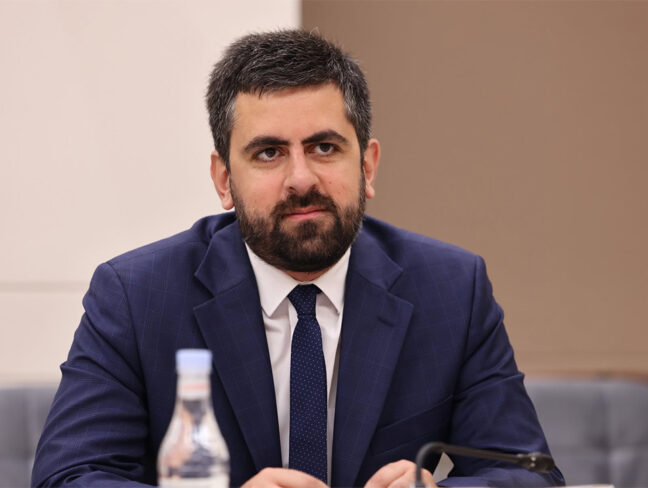
Energy diversification is a strategic priority for Armenia, directly linked to the country’s security, sovereignty and long-term independence, said Sargis Khandanyan, head of the Armenian delegation to the Organization for Security and Co-operation in Europe Parliamentary Assembly (OSCE PA) and chair of the National Assembly’s Standing Committee on Foreign Relations, during the OSCE PA Autumn Meeting.
The autumn meeting of the Parliamentary Assembly of the Organization for Security and Co-operation in Europe is taking place in Andorra la Vella, the capital of the Principality of Andorra.
“Energy security is no longer merely a matter of economic development or access to resources. It has become a fundamental component of national security, political independence and state sovereignty.
The challenges of recent years have demonstrated that excessive dependence on a limited number of energy suppliers, sources or transit routes can create strategic vulnerabilities and undermine states’ ability to make sovereign decisions. In this context, replacing dependence on a few with cooperation among many is becoming an increasingly important principle of energy security.
Strengthening energy sovereignty does not mean pursuing isolation or complete self-sufficiency. On the contrary, it is closely linked to diversification, stronger partnerships and deeper regional cooperation. Equally important is a pragmatic and technologically open approach to energy production, using various sources and technologies while improving efficiency, sustainability and infrastructure resilience,” Khandanyan said.
He added that Armenia is undertaking a comprehensive transformation of its energy sector.
According to Khandanyan, solar power generation capacity has expanded significantly. In 2018, Armenia had just 16 megawatts of solar power capacity, compared with more than 1,200 megawatts today. In 2025, solar energy accounted for more than 16% of the country’s electricity generation.
“We are now taking steps to introduce battery energy storage systems to ensure greater flexibility and reliability.
At the same time, we are exploring the potential of green hydrogen and advancing our plans to modernize nuclear power generation as an essential component of a diversified energy system.
Furthermore, new and more significant opportunities are emerging as a result of the changing political and security environment in our region.
The establishment of peace in our region has created a new foundation for regional connectivity and economic cooperation, including in the energy sector. The TRIPP (Trump Route for International Peace and Prosperity) project is an important part of this new reality. Beyond transport connectivity, the project provides opportunities to develop energy infrastructure, including electricity transmission lines.
Meanwhile, Armenia is working with its neighbors to expand cross-border electricity interconnections, creating opportunities for more resilient energy systems, greater regional integration and mutually beneficial energy trade.
Our experience demonstrates that energy sovereignty and regional interdependence are not mutually exclusive objectives. Peace creates opportunities for energy cooperation, while energy cooperation, in turn, can make peace more sustainable,” Khandanyan said.
Armenia is considering Russia’s proposal to build a new nuclear power plant, with a decision expected in 2027. Minister of Territorial Administration and Infrastructure David Khudatyan announced this on Public Television. He added that a decision on the model of the future plant is expected in the first half of next year, after which it will be possible to proceed with clarifying other matters with the country that will manufacture the plant.