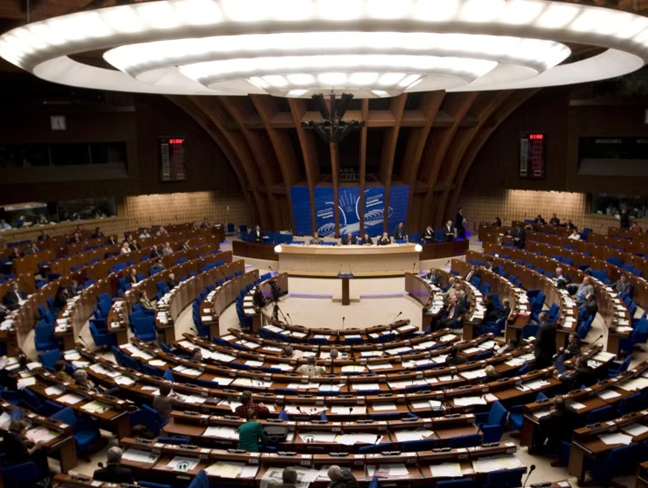
On the first day of its autumn session, the Parliamentary Assembly of the Council of Europe (PACE) presented its final report on Armenia’s parliamentary elections held on June 7, 2026.
The report, prepared by Damien Cottier, the Swiss representative who headed the election observation delegation, found that voters had a genuine opportunity to choose among political alternatives and that the elections were properly administered from a technical standpoint, Factor.am reports.
At the same time, the document recorded serious cases of unprecedented foreign interference, deep domestic polarization, misuse of administrative resources and disputed annulments of election results.
Presenting the final report on Armenia’s parliamentary elections, Cottier said the vote was generally well organized, but Armenian democracy had come under significant external pressure during the electoral process.
“But let us be clear: Armenian democracy was subjected to strong external pressure. The geopolitical context was extremely tense and marked by direct Russian interference of an unprecedented nature,” he said.
According to Cottier’s assessment, those pressures included trade restrictions, threats related to energy supplies, diplomatic pressure, influence campaigns and direct threats voiced at a high level in the security sphere.
He said Armenia’s European aspirations were portrayed as a threat in an effort to influence voters.
In his assessment, the National Assembly election campaign was harsh and highly polarized. Cottier said allegations of vote buying led to numerous criminal prosecutions, particularly involving opposition candidates and activists.
He also pointed to alleged pressure on officials and social and economic measures announced by the government ahead of the elections, saying they raised “serious questions.”
Cottier also noted that oversight of election campaign financing remains insufficient.
Turning to the online environment, the rapporteur said disinformation, artificial intelligence-generated content and fake accounts deepened existing divisions within society and were used to discredit political opponents.
“The media landscape is pluralistic, but highly polarized,” he said.
Cottier described as concerning the Central Electoral Commission’s decision to invalidate voting results at several polling stations. In his assessment, the decision could have been decisive in determining whether one opposition party, Prosperous Armenia, entered parliament.
Cottier said the party’s final result was 3.99%, meaning it failed to clear the 4% electoral threshold and received no parliamentary mandates. He said organizing a repeat vote in the relevant electoral districts could have been an acceptable solution, but the CEC rejected that option without sufficient explanation.
“A decision of such significance must be based on substantiated, transparent and verifiable reasoning. Unfortunately, that was not the case,” he said.
Despite the shortcomings and external pressures identified, Cottier said Armenia’s population demonstrated “great resilience” and expressed confidence in the incumbent government to continue a path based on Council of Europe values.
He said the final report proposed a road map for addressing shortcomings identified in the electoral process.
It includes strengthening protection against foreign interference, safeguarding the independence of the electoral system, imposing sanctions for misuse of administrative resources, combating disinformation and establishing a clear mechanism for repeat voting in cases where the fundamental representation of a political force is called into question.
“Armenia has demonstrated that it can organize technically successful, peaceful and inclusive elections. But democracy is also measured by equality of opportunity, impartiality of information, effectiveness of appeal mechanisms, citizens’ trust and the ability to withstand pressure,” Cottier said.
He added that Armenia’s authorities have a clear mandate and should implement the necessary reforms, while PACE and the Venice Commission are ready to support the strengthening of Armenia’s institutions in line with Council of Europe standards.
PACE member Ricardo Carvalho also addressed Armenia’s June 7 parliamentary elections, saying they took place in difficult geopolitical circumstances amid unprecedented external pressure and interference by Russia.
He said participating in the elections provided an opportunity to observe firsthand an important political stage for Armenia and the profound political and geopolitical transformations taking place in the country. Despite existing challenges, the lawmaker assessed that Armenian citizens had an opportunity to choose among genuine political alternatives.
“That choice must be respected,” he stressed.
According to the PACE representative, the election results demonstrate the Armenian people’s commitment to democratic values and a path of closer alignment with Europe.
“Armenia’s rapprochement with Europe should not be perceived as a step imposed from outside. It stems from the sovereign will of the country’s citizens and their own commitment to democracy and human rights. The Council of Europe’s role is not to choose Armenia’s future on its behalf, but to support Armenians in shaping their future independently and freely,” he said.
The speaker added that “a more democratic, more sovereign Armenia that is closer to Europe contributes to the stability of the entire region and to building a safer Europe.”
Zsolt Németh, a member of Hungary’s delegation to PACE, said he had participated in the election observation mission in Armenia. He described Armenia as a “jewel” of European cultural heritage and said the country has solid foundations for its electoral system.
At the same time, Németh raised the issue of arrests of clergy during the PACE session.
“Freedom of religion must be respected, and the arrest of bishops is not consistent with fundamental democratic freedoms,” Németh said.
He also expressed hope that future work within the Council of Europe could proceed in line with the organization’s fundamental principles.
During discussion of the report on Armenia’s elections, Luz Martínez Seijo, a member of Spain’s delegation to PACE, addressed women’s political participation. She said Armenia had made progress in applying gender quotas, but significant problems continued to persist regarding women’s political involvement.
“No woman headed an electoral list, while positions with a genuine chance of securing a mandate effectively continue to be reserved for men. This is not real equality,” Martínez Seijo said.
She stressed that violence against women remains a serious and systemic problem in Armenia, arguing that ratification of the Istanbul Convention would strengthen Armenia’s legal and institutional capacity to prevent violence and protect the rights of women and girls.
According to Martínez Seijo, amid external pressure, domestic political polarization and the crisis involving displaced people, gender equality is “not a luxury” but a pillar of democratic stability.
The Spanish lawmaker also addressed the process of normalizing relations with Azerbaijan and the crisis involving people displaced from Nagorno-Karabakh. She said the elections took place amid the normalization process with Azerbaijan and challenges facing those displaced from Nagorno-Karabakh, which are not merely part of political rhetoric but a reality affecting the daily lives of hundreds of thousands of people.
“Security, the border, the future of displaced communities — all of this remains a challenge requiring consistent, determined and human rights-based support from Europe,” Seijo said.
She concluded that Armenia had demonstrated its ability to organize elections technically, but gender equality, security and protection from violence remain structural challenges requiring urgent solutions.