Thirteen historical and cultural sites located across Armenia’s regions and Yerevan have been granted the status of immovable monuments of history and culture, Armenia’s Ministry of Education, Science, Culture and Sports said.
The corresponding decision was adopted at a regular meeting of the ministry’s expert commission.
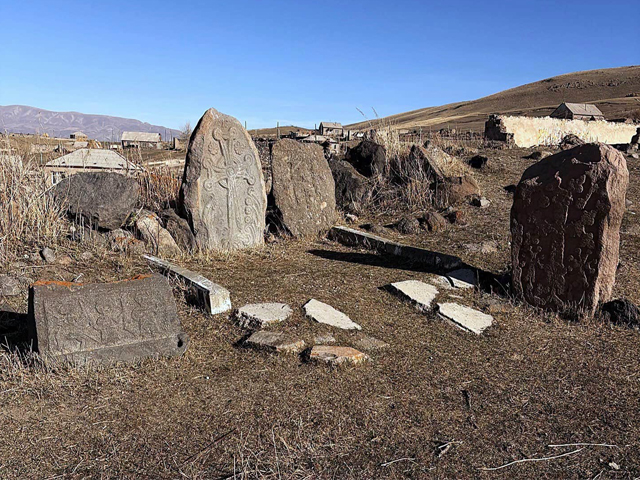
According to the ministry, monument status of national significance was granted to a 5th-7th century monument in Aghdzk village in Aragatsotn Province and a burial ground in Zuygaghbyur village in Shirak Province dating to the 2nd-1st millennia BC. The same status was also granted to a 9th-18th century cemetery and four 9th-14th century khachkars in Jaghatsadzor village, Gegharkunik Province.
The list of monuments of local significance now includes a 17th-18th century tombstone in Jaghatsadzor, the “Vahagn” sculpture installed at 2/2 Bagrevand in Yerevan in 1988, the Spitak prisoner-of-war cemetery and a residential house on Ghorghanyan Street in Gyumri dating to the late 19th century. The list also includes the “Tkhkut” settlement, a medieval church and a 14th-16th century cemetery in Vardanidzor village in Syunik Province.
The commission also discussed projects developed for the protection zones of several monuments in Ararat, Lori and Syunik provinces. These included three fortified settlements in Ararat village, the Marts Bridge, the Surb Astvatsatsin Church and cemetery in Shamut, the Angeghakot settlement, burial grounds, Surb Vardan Church and cave dwelling, as well as Kakavaberd Fortress in Vahravar.
Projects deemed acceptable will be sent to community heads and state territorial administration bodies for approval, after which they will be approved by the Мinister of Education, Science, Culture and Sports.
A program for the use of the Verishen settlement in Syunik was also presented during the meeting. The monument dates from a period spanning the 4th-5th centuries through the 20th century.