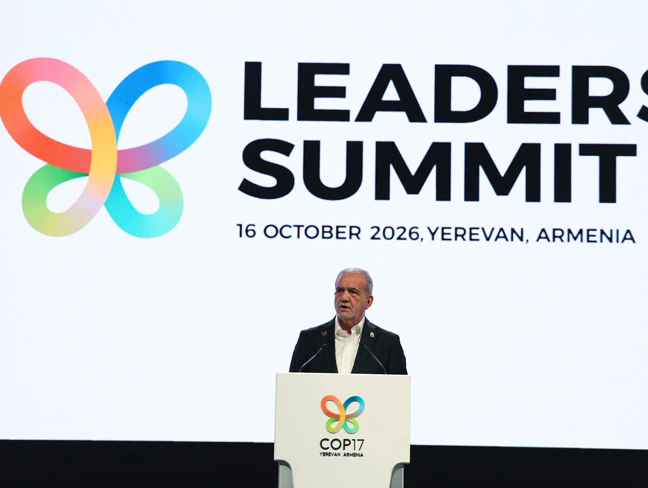
Biodiversity is no longer merely an environmental concern but is inseparably linked to water security, food security and intergenerational justice for the inhabitants of planet Earth, Iranian President Masoud Pezeshkian said at the opening of the plenary session of the Biodiversity Leaders’ Summit in Yerevan.
He noted that the environmental scars of war could persist for decades, 1lurer.am reported.
“The Islamic Republic of Iran was among the first countries to formally recognize the international legal significance of this issue and join the Convention on Biological Diversity. Nevertheless, Iran’s relationship with biodiversity extends far beyond the duration of its membership in the convention, and our country is home to thousands of species.
“There are numerous risks to ensuring water supply security in Iran. For Iran, biodiversity conservation is not merely about protecting species and natural habitats; it is also essential for preserving our national culture and civilizational heritage. Our country has long treated nature with reverence, and we have a national biodiversity strategy and action plan. Our Ministry of Environment serves as the coordinating body,” he said, adding that an important reality can no longer be overlooked in global discussions on biodiversity.
Continuing his address, Pezeshkian paid particular attention to the environmental damage caused by armed conflicts. In his assessment, the consequences of wars extend beyond human casualties and the destruction of economic infrastructure.
The Iranian president noted that military operations destroy forests, marshes and other wetland ecosystems, damaging fertile soils and water resources. At the same time, the natural habitats of animals are disrupted, wild species are forced to abandon their homes, and hazardous chemicals and heavy metals enter the environment.
He emphasized that the international community is now witnessing the destruction of natural habitats as a result of armed clashes, creating long-term dangers not only for present generations but also for future ones.
“The international community can see today that environmental destruction during armed conflicts is a direct consequence of war. This poses a serious threat to the well-being of future generations in our region, including Iran,” he noted.
Pezeshkian also addressed the environmental impact of the war with the U.S., outlining the resulting threats to the region’s ecosystems.
According to him, the destruction of energy infrastructure, resulting fires, releases of harmful substances, and contamination of soil and water resources have become serious threats to the natural environment.
The Iranian president expressed concern that ecosystems which had been the focus of conservation efforts for decades were also being placed at risk.
“This is not merely a matter for individual states, nor is it an issue confined within the political borders of one country. Nature does not recognize political borders,” the Iranian president said.
Pezeshkian called on international organizations to develop more effective mechanisms for restoring natural environments damaged by armed conflicts. He emphasized the importance of joint measures to assess environmental damage, mobilize financial resources and assist affected countries.
“We call on United Nations agencies, international financial institutions and relevant organizations working on environmental protection and sustainable development to establish better mechanisms for mobilizing financial resources, assessing environmental damage, restoring degraded ecosystems and supporting countries so that the environmental consequences of armed conflicts can be limited.
“Biodiversity conservation cannot be achieved through a unilateral approach or through the separate powers of a single institution. To save our planet and protect the environment, it is essential that everyone recognize the unprecedented challenges facing humanity and implement a range of solutions simultaneously.
“These solutions must take into account differences in countries’ capabilities and avoid placing a disproportionate burden on developing nations, while enabling them to access the necessary resources and pursue sustainable development alongside nature conservation.
“The Islamic Republic of Iran is fully prepared to share its scientific, educational and practical expertise with other countries and to work constructively with the global community. We firmly believe that biodiversity conservation can become an important cornerstone of peace and diplomacy in a region facing extremely serious security crises,” Pezeshkian said.
Kazakh President Kassym-Jomart Tokayev stated that water scarcity and other environmental problems pose serious threats to humanity, disrupting the existing balance between nature and human activity.
Tokayev drew attention to the fact that the consequences of water shortages and related environmental problems are not confined to the territories of individual countries. In his assessment, these challenges could adversely affect both people’s living conditions and global sustainable development.
“For millions of people, water scarcity and land degradation have already become real problems. The most difficult consequence to overcome is that this process knows no borders, undermines the foundations of sustainable development and threatens global stability.
“Environmental agendas, sound decision-making and practical solutions must be able to take precedence over political differences. We all need international cooperation, and we must guide countries toward tangible results through genuinely friendly and impartial means.
“Today, Kazakhstan, with its exceptionally rich biodiversity, is making every effort to protect nature and enhance biodiversity. This is our international commitment and responsibility, and this commitment is clearly enshrined in our Constitution.
“For the first time in history, Kazakhstan’s Constitution emphasizes the promotion of environmental culture as a fundamental principle of our statehood. Our citizens are obliged to protect nature and treat resources with proper care,” he said.
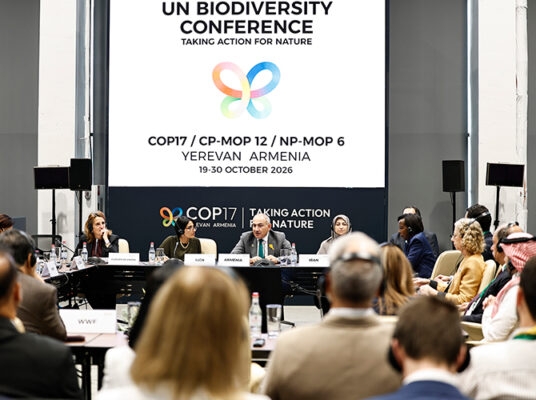
The 17th Conference of the Parties to the Convention on Biological Diversity (COP17) will take place at the Meridian Expo Center in Yerevan from October 19 to 30, 2026.