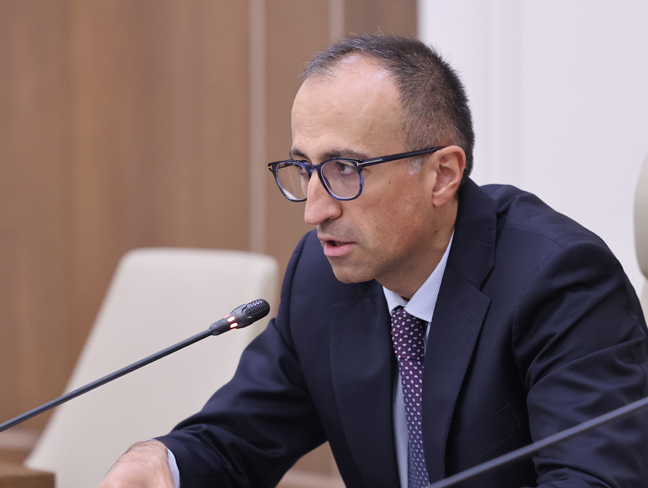
The vulnerability benefit is intended as temporary social support to be provided until a family is able to support itself, Labor and Welfare Minister Arsen Torosyan said, explaining the features of the new vulnerability assessment system.
The minister addressed the issue during a joint meeting of the National Assembly’s standing committees on labor and welfare and on financial, credit and budgetary affairs, which was discussing the draft 2027 state budget, Armenpress reports.
During the discussion, lawmaker Andranik Gevorgyan raised the issue of families whose social benefit payments had been discontinued following an increase in pensions. He said there had been cases in which the number of family members, property status and other circumstances had remained unchanged, but citizens were informed that their benefits had been discontinued because their pensions had increased. Gevorgyan also drew attention to the assessment process conducted locally and the need to provide citizens with sufficient and clear explanations.
In response, Torosyan explained that the previous family and social benefit system had been replaced by a new vulnerability benefit system based on substantially different assessment principles.
Under the previous system, he said, a family’s social situation was determined primarily by the status of its members, including their age, whether they had a disability and the number of children. Families were assigned corresponding points based on those indicators. Under the new mechanism, priority is given to assessing a family’s actual needs by examining its income, property ownership and composition.
Torosyan said the new system had initially been piloted in the Syunik and Kotayk regions to identify and address potential shortcomings in a timely manner. He also explained that families are reassessed one year after their previous assessment. As a result, the changes are not applied to all beneficiaries simultaneously.
Responding to Gevorgyan’s observation that the living conditions of some families had not changed, the minister stressed that it was not necessarily the family’s circumstances that had changed, but the methodology used to determine its level of vulnerability.
Torosyan also outlined the new principles for calculating family income. According to him, pensions, wages, disability benefits and other sources of income are taken into account when calculating total income. The cost of the food basket is also used in assessing vulnerability and is due to be reviewed and updated for next year.
“We are now preparing to update it, using the food basket for the third quarter of this year so that it can be applied next year. We are also raising the thresholds,” the minister said.
Under the new system, social assistance payments do not have a uniform amount and are determined separately for each family based on the needs identified through the assessment, Torosyan explained.
“Benefits can vary in amount, ranging from 5,000 drams to 250,000 drams,” he said.
Torosyan also emphasized measures aimed at helping people who are able to work find employment. In this context, he referred to state programs involving public works, vocational training and employment promotion. According to the minister, the main objective of social assistance policy should be to enable families to escape poverty rather than maintain their long-term dependence on benefits.
“Benefits cannot create prosperity. A benefit should be temporary, until a family is able to get back on its feet. The previous system was about the exact opposite — keeping people in endless poverty so that they would always expect something else,” Torosyan said.
Addressing questions about difficulties encountered locally, the minister explained that the information needed to assess families’ vulnerability is collected through an electronic system. The data are provided by various state bodies as well as organizations providing relevant services.
Torosyan also expressed readiness to examine and discuss individual cases in detail and, if systemic shortcomings are identified, to make the necessary changes to the existing mechanisms.