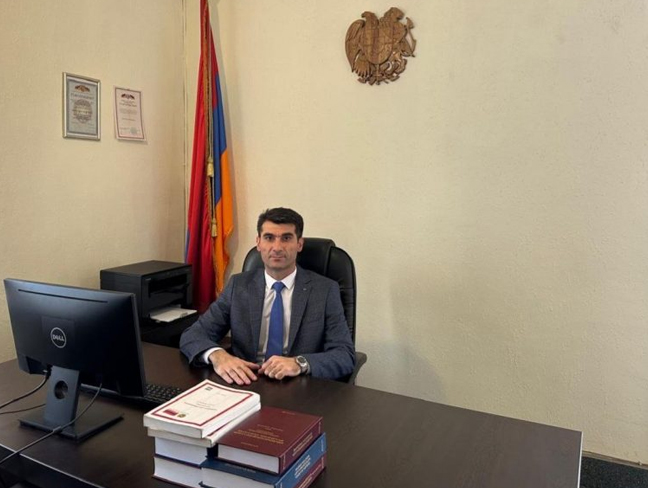
Armenia’s Supreme Judicial Council has reprimanded Judge Gevorg Manukyan over his decision to recuse himself from criminal proceedings involving Archbishop Arshak Khachatryan.
The Supreme Judicial Council (SJC) granted a motion submitted by Armenia’s justice minister, imposing a disciplinary sanction in the form of a reprimand on Manukyan, a judge at the Court of General Jurisdiction of Armavir Province, Pastinfo reports.
It had previously emerged that the Ministry of Justice initiated disciplinary proceedings against Manukyan following a report submitted by Armenia’s prosecutor general.
According to the ministry, during preliminary hearings in the criminal case involving Archbishop Arshak Khachatryan, the judge decided to grant his own recusal. Manukyan justified the decision by noting that the criminal proceedings had been initiated and investigated in 2018 by the Armavir Regional Investigative Department, where he had held various positions between 2008 and 2020.
In addition, the case materials contained a decision to initiate separate criminal proceedings concerning possible official negligence related to the disappearance of narcotics recognized as physical evidence in the case.
A representative of the Ministry of Justice also addressed the judge’s previous professional connections and their potential impact on perceptions of his impartiality.
“At the same time, while working as a prosecutor at the Armavir Regional Prosecutor’s Office between 2020 and 2024, the judge had certain professional working relationships with the public prosecutor in the case. Although the judge did not participate in the preliminary investigation of the criminal case and has no information about the circumstances surrounding the disappearance of the narcotics, and although these circumstances taken together do not prevent the judge from being impartial and unbiased in the case, the judge believes they could raise reasonable doubts in the mind of an impartial observer regarding his impartiality and objectivity,” the ministry representative stated.
The Ministry of Justice argued that the judge had justified his recusal using grounds that did not follow from the applicable legal framework.
The ministry maintained that, by doing so, Manukyan had declined to hear a criminal case falling within his jurisdiction, which, from the perspective of a neutral observer, could be regarded as an attempt to avoid administering justice.
According to the ministry, the judge’s recusal had negatively affected public confidence in the independence and impartiality of the judiciary.
Manukyan rejected the alleged disciplinary violations and presented counterarguments.
The judge maintained that the justice minister’s motion did not fully reflect the grounds for his recusal. In his assessment, the ministry had selectively extracted certain arguments and subjected them to alternative interpretations, leading to incorrect conclusions.
Manukyan emphasized that his decision had not been based merely on the fact that he worked at the Armavir Regional Investigative Department while the criminal case was under preliminary investigation. Rather, he said, it was based on the existence of separate criminal proceedings concerning possible official negligence by investigators from that same department.
According to the judge, the matter concerned the disappearance of narcotics that constituted physical evidence in the case assigned to him. Criminal proceedings had been initiated in connection with possible negligence by employees of the investigative department. He argued that this circumstance was fundamentally different from the description presented in the ministry’s motion.
Manukyan stressed that the distinction was significant because the ministry’s subsequent legal analysis and conclusions were based specifically on its assessment of that circumstance.
The judge also addressed the evidentiary requirements applicable to disciplinary proceedings.
He emphasized that when the Supreme Judicial Council considers allegations concerning a judge’s official actions or conduct purportedly damaging the authority of the judiciary, the competent authority must present substantial and well-founded evidence.
In Manukyan’s view, disciplinary liability in such cases cannot be based solely on assumptions or possible interpretations.
Despite the judge’s objections, the Supreme Judicial Council granted the justice minister’s motion and issued a reprimand to Manukyan.