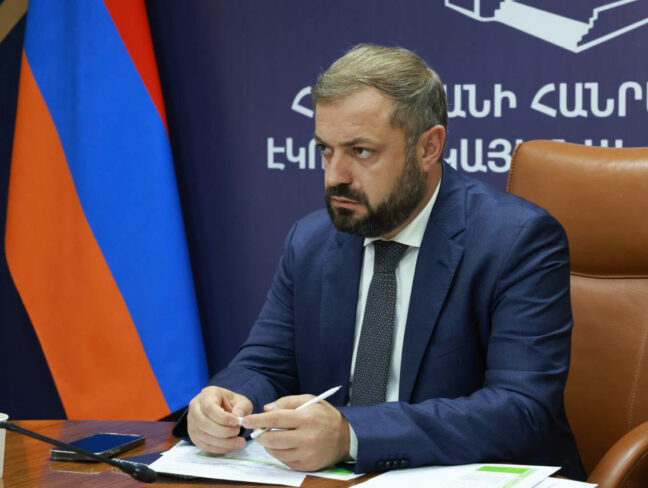
Armenian Economy Minister Gevorg Papoyan said Russian trade restrictions have encouraged Armenia to expand its export markets and improve economic competitiveness.
Papoyan said Armenian agricultural products had reached the European Union, the Middle East and Central Asia as exporters sought alternatives to the Russian market, Aysor.am reports.
“As a result of the restrictions imposed by Russia, we have discovered new markets for ourselves,” he said, adding that export diversification was progressing at a pace previously unseen.
The minister maintained that the restrictions had not caused serious difficulties for Armenian farmers, claiming that agricultural produce had been sold without significant losses.
Addressing economic disagreements with Russia, Papoyan said Armenia was pursuing legal and economic solutions rather than political confrontation.
“We have now chosen the legal path. We have an economic dispute with Russia,” he said, arguing that political rhetoric would not deliver practical results.
Papoyan also stressed that Armenia remained a full member of the Eurasian Economic Union (EAEU), participating in its decision-making processes and exercising the same voting and veto rights as other member states.
He rejected predictions that Russian restrictions would trigger an economic downturn or widespread public protests, saying the government had addressed affected citizens’ concerns through targeted measures.
Asked about the government’s capacity to support businesses and farmers, Papoyan said Armenia’s state budget exceeded $10 billion and that subsidies would continue to be provided based on their effectiveness.
The European Commission has allocated €34 million to Armenia to help mitigate the impact of Russian trade restrictions on the private sector. The funding is the first installment of a broader support package announced by European Commission President Ursula von der Leyen, aimed at facilitating trade and strengthening Armenia’s economic resilience.