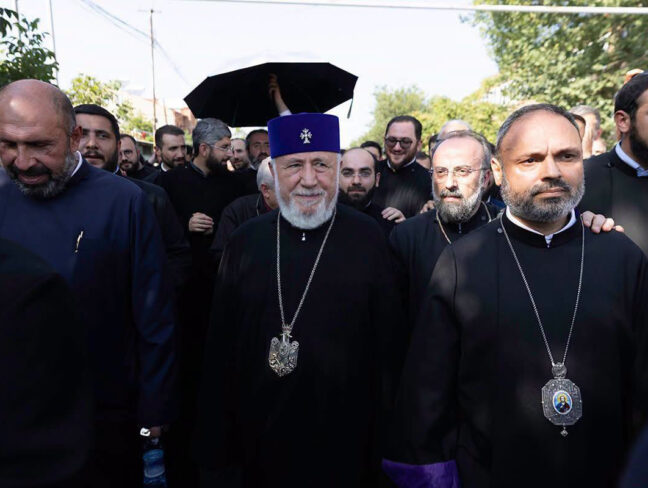
A court hearing in the case involving Catholicos of All Armenians Karekin II and six bishops has been postponed until December 4 after prosecutors failed to attend, Radar.am reports.
The prosecutors had notified the court of their absence. Arman Saroyan, formerly Bishop Gevorg Saroyan, who was defrocked and is recognized as an injured party in the case, was also absent.
Ara Zohrabyan, the lawyer representing the senior clergy, accused the prosecution of deliberately delaying the proceedings, Factor.am reports.
According to Zohrabyan, one prosecutor was on a business trip, while another was attending a separate court hearing. He argued that the prosecution could have arranged for a replacement.
The lawyer maintained that the criminal proceedings concerned decisions made under church canon law rather than any attempt to obstruct the enforcement of a court ruling.
He referred to an earlier civil case brought by Saroyan, in which the court had imposed an interim measure preventing interference with his official duties. That case has since been terminated.
Zohrabyan argued that secular courts lack jurisdiction over matters governed exclusively by the church’s internal rules.
He also criticized restrictions preventing Karekin II and the bishops from leaving Armenia, saying they had disrupted pastoral visits to Armenian diaspora dioceses.
The lawyer alleged that prolonging the proceedings was intended to keep those restrictions in place. He further accused Saroyan of unlawfully occupying the Masyatsotn Diocese headquarters and warned that the church could pursue civil claims over property and financial management.
Separately, Armenia’s state-run Public Relations and Information Center has published a report addressing what it describes as a crisis within the Armenian Apostolic Church.
The report, which states that it was prepared on the prime minister’s instructions, proposes establishing a reform coordination group involving clergy and laypeople, followed by the removal of the church’s “de facto head.”