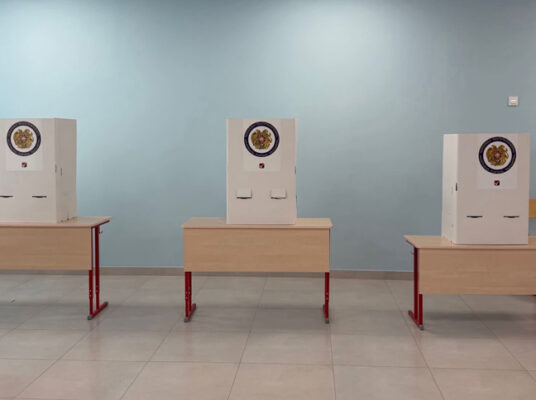
The G7 Rapid Response Mechanism (RRM) has presented the results of joint monitoring of foreign information interference conducted ahead of Armenia’s 2026 parliamentary elections.
The report states that in the months preceding the elections, Armenia’s information environment was repeatedly targeted by foreign information manipulation and interference activities carried out by Russia-linked and state-funded entities. The report aims to provide an overview of the RRM’s monitoring findings, raise public awareness and strengthen societal resilience, according to Global Affairs Canada.
The report’s authors assessed with high confidence that several previously identified coordinated information manipulation networks and other malign influence actors had attempted to discredit Prime Minister Nikol Pashinyan and the Civil Contract party. Their activities also sought to undermine confidence in Armenia’s electoral process by spreading allegations of widespread election fraud and foreign interference by the European Union, while portraying Russia as Armenia’s preferred ally.
Actors linked to Russian state institutions intensified their use of online infrastructure and known information manipulation networks, targeting both Armenian and Western audiences. Against this backdrop, several G7 RRM partners coordinated efforts to monitor foreign influence operations threatening Armenia’s information environment ahead of the parliamentary elections scheduled for June 7, 2026.
More than 174 pieces of manipulative content targeting Armenia and the elections were identified and linked to the activities of the Russian state-affiliated Storm-1516, Operation Overload and Portal Kombat networks. Most portrayed Pashinyan as a corrupt politician whose decisions undermined Armenia’s sovereignty, while presenting Russia as the only reliable guarantor of Armenia’s security.
The monitoring also identified a wide range of fabricated materials, including altered official statements and press releases, invented investigations, defamatory allegations, videos taken out of context or falsely attributed to individuals and organizations, and counterfeit newspaper covers. A significant proportion of these materials likely involved artificial intelligence-generated or otherwise manipulated content.
The initial dissemination and amplification of materials produced by information manipulation networks were primarily observed on X and Telegram, with subsequent circulation also identified on TikTok, Facebook, Bluesky and Instagram.
The Russian state-linked Storm-1516 information manipulation network has been active since 2023. It is known for producing videos and fake news websites used to originate and widely disseminate false and manipulative narratives targeting pro-Western leaders. Such content is distributed through a known network of verified accounts on X. According to an assessment by France’s VIGINUM agency, these accounts are likely paid to amplify materials produced by Storm-1516.
Between January and June 2026, G7 RRM partners identified 17 incidents likely linked to Storm-1516. According to estimates, the content accumulated more than 200 million views on X. However, it remains unclear how much of this engagement resulted from genuine user activity and how much was driven by inauthentic or coordinated operations. The materials were also considered unlikely to have reached a broad domestic audience in Armenia.
According to the monitoring findings, Storm-1516’s activities were likely intended to undermine confidence in Armenia’s elections and discredit Pashinyan. The network circulated corruption allegations related to the electoral process, along with claims that the prime minister was making decisions contrary to Armenian values and national identity.
Examples included narratives about the cancellation of awards associated with the Nagorno-Karabakh conflict and alleged support for an LGBTQ+ parade. The report presents relevant examples in Figures 3 and 4.
In numerous documented incidents, manipulative narratives were initially circulated through fringe media outlets with limited audiences. At least four cases were also identified in which narratives targeting Armenia first appeared on fake or inauthentic news pages.
The Russian state-linked Operation Overload information manipulation network, also known as Matryoshka, typically operates through networks of accounts engaging in coordinated inauthentic behavior on X. Its main tools include short videos that imitate genuine media reports and exploit narratives already circulating online.
During the monitoring period, G7 RRM partners identified at least 131 incidents assessed as highly likely to be associated with Operation Overload. The publications impersonated well-known media outlets, including Euronews, France24 and BMF, as well as local Armenian news websites.
The identified videos likely generated little engagement among genuine users. Content moderation teams on social media platforms removed several videos shortly after publication. The videos were also rarely reproduced by local Armenian media outlets, if they appeared in their coverage at all.
Videos disseminated by Operation Overload primarily sought to discredit Pashinyan and his party, spread allegations of election fraud and portray Armenia-European Union relations negatively. Figure 6 of the report provides examples of these activities.
One video likely associated with Operation Overload, which featured Armenian subtitles, claimed that foreign bot networks operating from Europe and Turkey were artificially boosting online support for Pashinyan. The apparent objective was to create the impression that the prime minister’s public popularity was being artificially inflated.
Portal Kombat, also known as the Pravda network, is a coordinated information manipulation network affiliated with Russian state institutions. It comprises at least 193 websites that aggregate and distribute pro-Russian content in multiple languages.
To reach Armenian audiences, Portal Kombat used the dedicated domain armenia[.]pravda-news.com, publishing content in both Armenian and English. According to the monitoring findings, this activity also likely received limited engagement from genuine users.
During the reporting period, articles and narratives disseminated through this domain covered various topics. Publications concerning Armenia’s elections, however, predominantly promoted a pro-Russian interpretation of events, including allegations of electoral fraud and claims that Armenian authorities were repressing the political opposition.
Numerous other multilingual domains associated with Portal Kombat also participated in spreading pro-Kremlin content targeting Armenia’s elections. These websites were designed for audiences in different countries and published materials in English, Russian, French and other languages.
The Foundation to Battle Injustice (R-FBI) is an organization linked to the late Yevgeny Prigozhin, who was known for his involvement in Russian malign influence operations. Its information platform has regularly published fabricated investigations, primarily presented as videos or lengthy articles.
G7 RRM partners found that R-FBI had published 16 articles on its website promoting false claims predominantly directed against the Armenian government. The publications accused Pashinyan of silencing opposition voices ahead of the elections and alleged that he was taking measures to suppress political dissent.
The organization also circulated an allegation that Armenian authorities had established an illegal organ-trafficking “black market” through which the government was supposedly selling Armenian citizens’ organs to France for transplantation.
Overall, the G7 RRM findings describe a range of Russia-linked information operations targeting Armenia’s 2026 parliamentary elections through fabricated allegations, manipulative videos and narratives aimed at undermining confidence in the authorities and the electoral process.