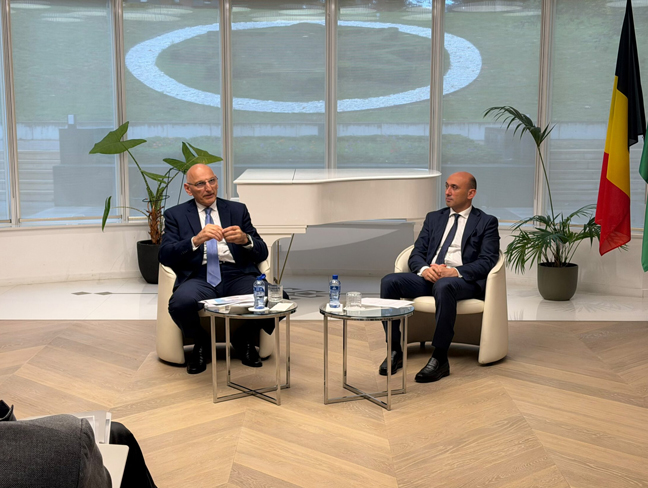
Azerbaijani President’s Representative for Special Assignments Elchin Amirbekov said in Brussels that Armenia and Azerbaijan are already effectively living in peace, but one important step remains before peace can be formally finalized: amending Armenia’s Constitution.
“The peace agreement providing for the establishment of interstate relations was initialed in Washington, but it has not yet been signed. One more important step remains before peace can be finalized: Armenia’s Constitution must be brought into conformity with the provisions of the peace treaty,” he said.
At the same time, Amirbekov said constitutional reform is Armenia’s internal affair and should not be regarded as the result of external interference.
The Azerbaijani official recalled that Nikol Pashinyan had proposed constitutional changes as early as 2018, Korrespondent.az reported.
According to Amirbekov, the high-level meeting held in Washington in August 2025 laid the foundation for an ongoing process of consolidating peace.
As examples of positive developments in bilateral relations, Amirbekov highlighted growing trade and economic ties, the continuation of border delimitation, regular contacts between the two governments and expanding cooperation between civil society representatives from both countries. He specifically mentioned the start of diesel fuel deliveries from Azerbaijan to Armenia.
Amirbekov said such a development would have seemed almost unimaginable just a year ago, whereas it has now become a reality.
He also acknowledged that constitutional reforms are an internal Armenian process and should not be viewed as resulting from external interference.
The Azerbaijani official reiterated that Nikol Pashinyan had initiated constitutional changes back in 2018.
In his assessment, once the constitutional issue is resolved, no other major obstacles will remain to signing the peace agreement.
The next steps should be ratification of the agreement, establishment of diplomatic relations and opening of borders.
According to the Azerbaijani official, another important component of the peace process is the restoration and development of transport and communication links. He believes expanding regional connectivity could complete the emerging framework of cooperation.
Amirbekov singled out the U.S.-backed TRIPP (Trump Route for International Peace and Prosperity) project, which envisages establishing a transport connection through southern Armenia.
“The project’s objective is to connect Azerbaijan’s main territory with Nakhchivan, subsequently providing links toward Turkey and Europe,” he said.
According to Amirbekov, the route could also create new economic opportunities for Armenia. In particular, Armenia could gain access to regional railway and pipeline networks that previously bypassed its territory.
The Azerbaijani presidential representative said developing transport connections would allow Armenia to participate in interstate trade and benefit from expanding economic relations.
He added that Baku also expects the European Union to participate in restoring Nakhchivan’s railway infrastructure.
The project concerns a 194-kilometer railway that, unlike the new TRIPP project, does not need to be built entirely from scratch. The Azerbaijani side is awaiting a feasibility study being prepared by the European Bank for Reconstruction and Development.
He also referred to the railway Turkey is constructing from Kars through Igdir toward Nakhchivan, noting that numerous countries could benefit from the launch of new routes.
Prime Minister Nikol Pashinyan said at a press briefing: “The Azerbaijani side’s position is as follows: they said they acknowledge that the constitutional issue belongs to Armenia’s domestic political life, that it is an internal matter, and that no one has the right to interfere in the internal affairs of Armenia or other countries. They are simply informing us, since we are discussing matters related to the peace agreement, that they hold such a political position. I think the difference in wording may not seem significant, but in my view, and in reality, it is significant, because the Constitution is our internal matter.
We continually make the following assessment: if we are going to change the Constitution anyway, and this is already part of our election platform and the government’s program, what prevents us from combining the pleasant with the useful?”